

- This event has passed.
ASENSE at ISFNT-16
ASENSE at ISFNT-16: Advancing Fusion Metrology
ASENSE will attend the 16th International Symposium on Fusion Nuclear Technology (ISFNT-16), held from November 9th to 14th, 2025, at the Knoxville Convention Center, Tennessee, USA—one of the world’s key gatherings for the fusion nuclear technology community.
At this major international symposium, ASENSE (formerly ASENSE Europe) will present the poster “Non-contact dimensional measurements of a flowing liquid metal surface relevant to the IFMIF-DONES lithium target.” Our team has developed and validated an advanced metrology system based on amplitude-modulated LiDAR (AM-LiDAR) for continuous, real-time monitoring of the thickness of fast-flowing liquid metals, fully compatible with the demanding conditions of the IFMIF-DONES lithium target loop.
In fusion research, the precise thickness of the lithium target—nominally 25 ± 1 mm—is critical for safe and optimal neutron generation. The IFMIF-DONES facility requires the lithium thickness to be constantly above 22.5 mm across a 200 mm × 50 mm beam footprint. To ensure facility safety, our system can trigger an interlock response should thickness fall below this threshold at any monitored point.
The ASENSE AM-LiDAR system operates from a remote diagnostic port 8 meters away, using phase-shift measurements of amplitude-modulated light to deliver accurate, non-contact distance readings. The system is robust under vacuum and radiation, continuously mapping the surface and thickness profile of the lithium jet. This allows for the real-time detection of flow irregularities, such as obstructions or nozzle failures, enhancing both safety and diagnostics in fusion facilities.
This development represents a significant contribution to the safe operation and diagnostics of fusion neutron sources and opens new avenues for advanced, non-invasive metrology in fusion facilities worldwide.
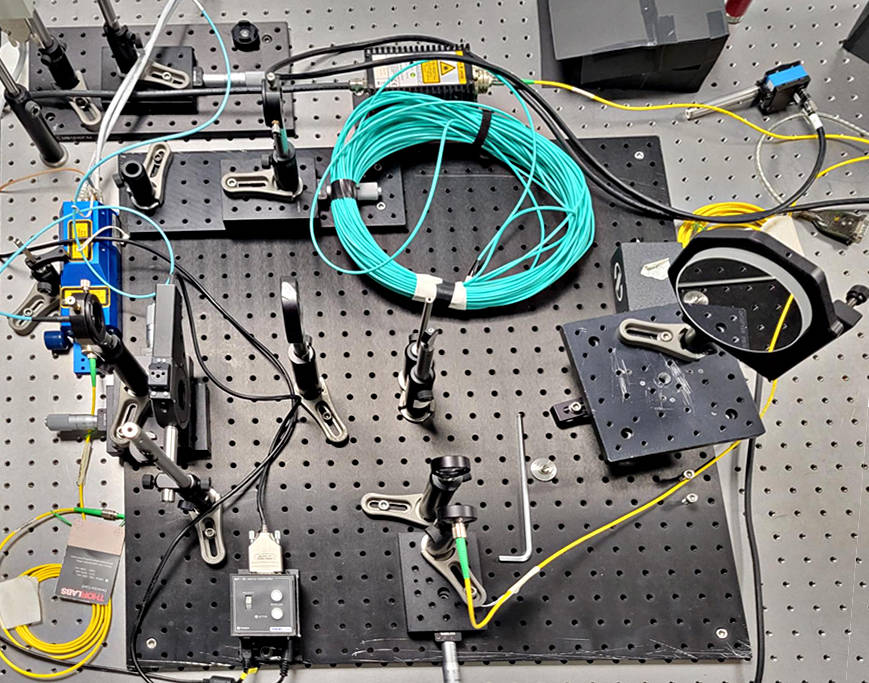
The AM-Lidar system is mounted on a breadboard to enhance the portability and mobility of the measurement setup.

Photographs taken with varying exposure times show the liquid GaInSn flow as it passes the observation window. Depending on the exposure time, you can observe either the turbulent flow regime or the standing wave regime.
This is a big step for fusion technology — and we can’t wait to share insights and connect with the global community driving the next generation of clean energy.
Contact us at sa***@********va.com to schedule a meeting with us during this event.
For more information about the event visit: https://isfnt-16.ornl.gov/
For more information about the IFMIF-DONES project visit: https://www.asensenova.com/project/dones-flux/