
State-of-the-art optical systems for Night Vision Systems
Currently, the technology of analog NVIS night vision systems is very mature, so the latest 3rd Generation image intensifier tubes (IITs) have a very high resolution, usually around 74pl/mm. However, the optical systems that are attached to it usually have a lower resolution than this one, so the final resolution of the assembly is limited by the optics and not by the tube itself.
New optics for high-end night vision systems
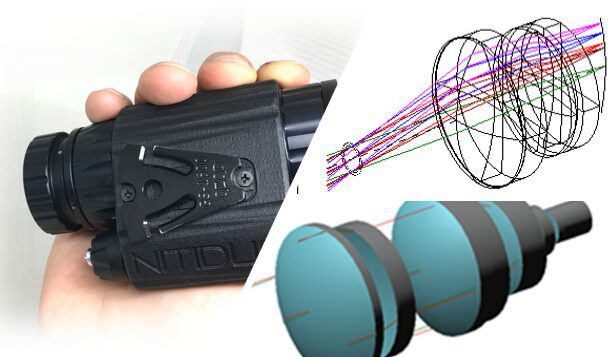
In its pursuit of excellence and within the framework of the COINCIDENTE Program, ASENSE has developed a 1x magnification monocular with the aim of producing high-end binoculars. To achieve this, the optical subsystems (eyepiece and objective) were designed using lenses that incorporate aspherical surfaces based on the normalized polynomial base QBFs to improve not only the resolution and transmission of each subsystem, but also the overall distortion. Furthermore, during the optimization process, a balance was struck between weight, dimensions, and overall optical quality, taking into account functional and productivity criteria.
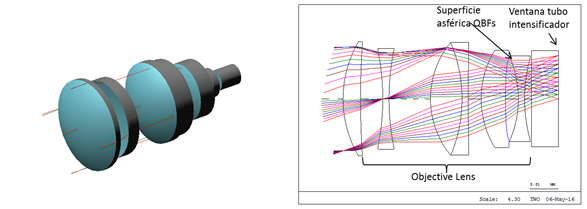
Figure 1. Optical diagram of the lens
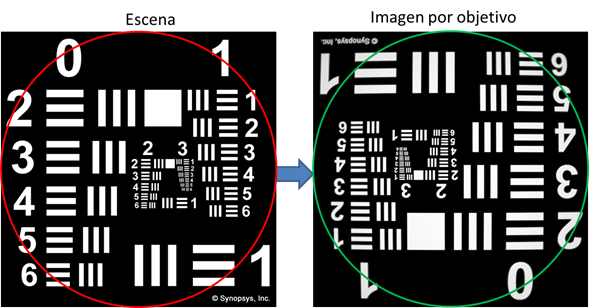
Figure 2, which we see below, shows the image simulation of the scene through the lens. The decrease in illumination and distortion is noticeable in the extreme field, but at the same time the image is sharp throughout the image grid.
In the specific case of the eyepiece, ASENSE designed it for a large pupillary emergence (25mm), taking into account eye movement to better fit the introduced QBF aspherical surface. The following image shows the eyepiece’s optical schematic with a simulated pupil.

Results: higher resolution, higher transmission
Both subsystems achieve resolutions greater than 74cl/mm in the focal plane and a transmission greater than 93%. Since they are designed to couple with each other, their distortion is compensated so that the monocular distortion is less than 4% for a total field of 40º. It is also worth noting that the weight of these subsystems is reduced by around 15% compared to other commercial systems, which improves the ergonomics of the product and, therefore, the user experience.