
ASENSE Scientific Articles
Two of our most recent scientific articles have just been published in the SPIE digital library.
The first, entitled “Compact high-resolution LWIR optical system for the MORERA mission: final configuration“, deals with the Cubesat-compatible camera that will be used to provide high-resolution agricultural images, delivering customized irrigation recommendations directly to end users via a mobile device.
A software-defined system will use Big Data to combine all relevant information (AEMET, Copernicus, and S-SEBI algorithms) to optimize water resources. This article describes the final optomechanical configuration, its performance, and its behavior in diffuse light.
This project represents a major step towards precision agriculture, using high-resolution images to optimize irrigation and improve the use of a vital natural resource: water. Read more about how we are innovating in the agricultural sector! The article is available here:
http://dx.doi.org/10.1117/12.3015435
The second article, entitled “Comparison of tolerance simulations and as-built optical performance in a precision optical system“, presents the results of an ASENSE study on increasing the accuracy of its optical design simulations.
To adequately account for imperfections in lens manufacturing and mechanics, as well as optical alignment limitations, a tolerance analysis must be performed during the optical design process. However, it is often unclear what level of detail the tolerance model needs to accurately predict performance variation, and there are time and cost consequences for both overly optimistic and overly pessimistic designs. In this work, we compare the results of assembling a precision microscope objective with an initially overly pessimistic tolerance analysis and develop an improved tolerance model that better reflects the performance of the as-built systems.
The system was analyzed using two industry-standard optical design packages, Zemax and CODE V, comparing the results with each other and with assembly data. Zemax’s Monte Carlo analysis closely matches the actual data by including manufacturing and assembly tolerance statistics, as well as by modeling the compensation procedures used in the lab. CODE V’s TOR and Monte Carlo analyses consistently produce similar results, but are more pessimistic than Zemax’s analysis. All three methods agree in reducing the irregularity tolerance in CODE V’s analyses to reflect the software’s different tolerance definitions. Although much faster, CODE V’s TOR cannot model complex compensation procedures, suggesting that a preliminary analysis in TOR should be followed by a more comprehensive Monte Carlo analysis to avoid over-specifying components. Several aspects of the tolerance model developed here are generalizable to other systems.
Discover how we’ve developed a more precise tolerance model for our optical designs to ensure our products meet the most demanding specifications. The article is available here:
http://dx.doi.org/10.1117/12.3016973
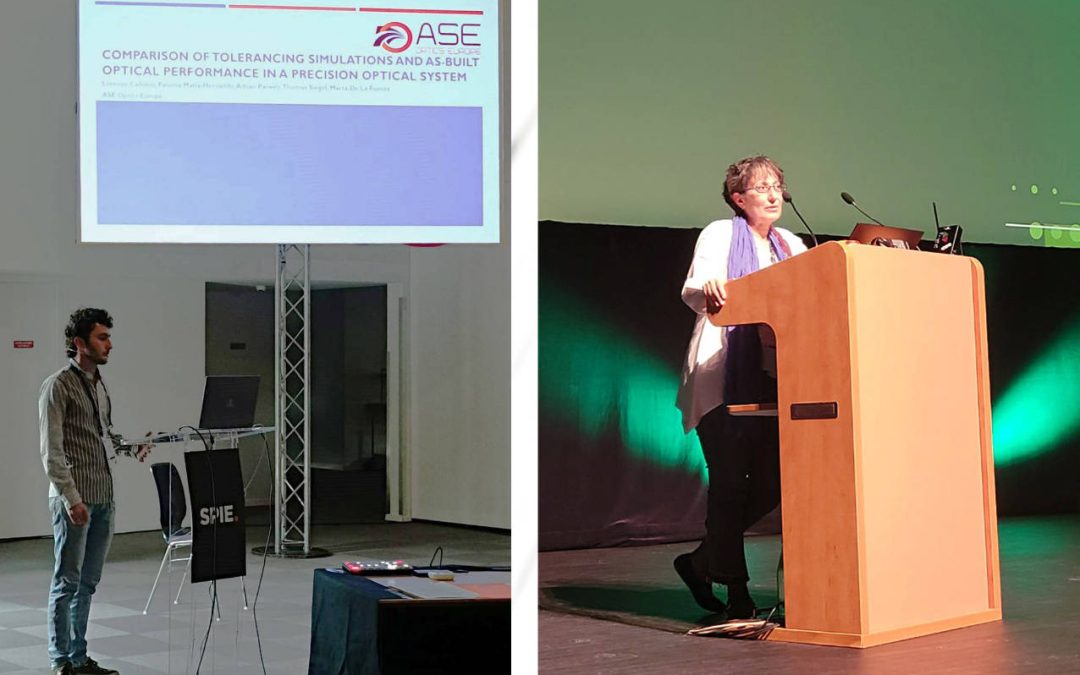
Both articles were initially presented by Marta de la Fuente and Lorenzo Calvano at the SPIE Optical Systems Design conference held in Strasbourg in April 2024.
If you enjoyed this post from “ASENSE Scientific Articles,” you might also be interested in reading “Photonics for the Agri-food Industry.“